

Build Momentum Before the Market Tests You
And why blind HODLing is a posture, not a strategy


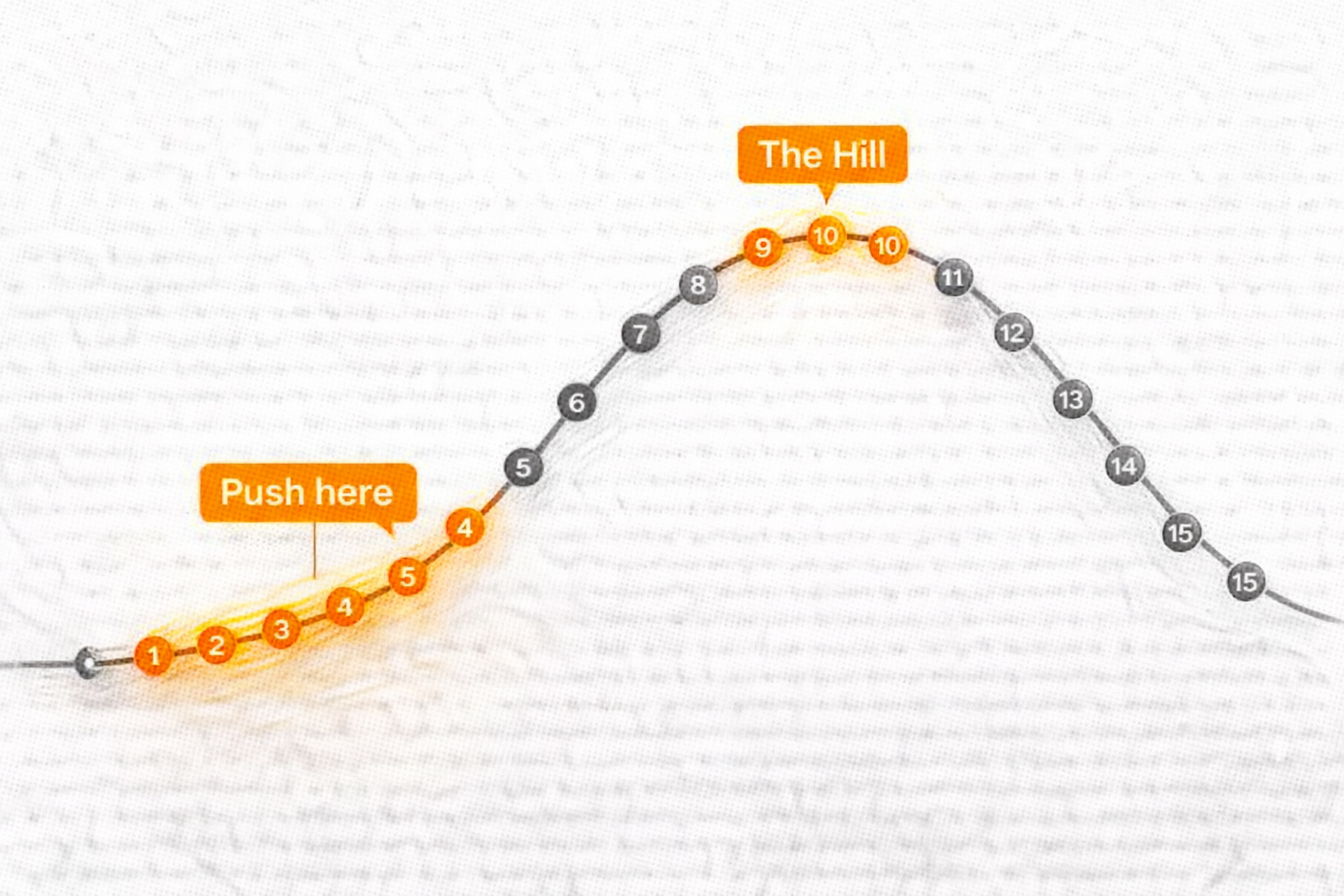
There’s a hill on my running route that shows up at about the 75% mark — right when I’m already tired and every instinct says to ease up. I’ve run this route enough times to know exactly where it comes. And I’ve learned something: the secret to getting up that hill has nothing to do with how hard I push *on* it.
It has to do with how hard I push *before* it.
The stretch leading into the hill is flat — technically the easy part of the route. But if I coast through that section, I arrive at the bottom of the elevation with nothing. No momentum. No rhythm. Just fatigue meeting resistance, and the quiet thought that maybe today is a good day to walk.
The runners who struggle most on that hill aren’t the ones who started too fast. They’re the ones who coasted into it. Building momentum while you’re already going uphill is almost impossible. You have to build it before the elevation starts, when the terrain still allows it.
Bitcoin has a hill too.
The Hill on the Route
The insight from that flat stretch is straightforward once you’ve experienced it a few times. The outcome at the hill is not determined at the hill. It’s determined by the momentum you built — or didn’t build — in the section just before it.
Push hard in the flat and the elevation feels manageable. You carry speed into the incline, your body can work with what it already has, and the top of the hill arrives before your mind has time to talk you into slowing down.
Coast through the flat and the hill demands everything you don’t have. The terrain rises, the pace drops, and the mental resistance tends to show up before the physical resistance does. Once those thoughts of wanting to stop creep in, they’re hard to quiet.
The difference between those two experiences is made entirely in the section that didn’t seem to matter.
Money works the same way.
Bitcoin Has a Hill Too
Bitcoin doesn’t move in a straight line, and anyone who has held it through more than one cycle knows this firsthand. The terrain shifts.
Market cycles create hill moments — sharp corrections where prices fall faster than logic seems to allow, prolonged bear markets where the drawdown extends much longer than any reasonable person expected, stretches where you’re significantly underwater and genuinely unsure how much further the decline will go. In those moments, holding Bitcoin requires something that buying it never did.
The terrain isn’t random, even when it feels that way. Bitcoin has followed a recognizable pattern across its history: accumulation phases where prices move slowly and most people lose interest, breakout periods where momentum builds and the narrative turns optimistic, euphoric peaks where the headlines are relentless and everyone seems to have an opinion, then corrections and contraction before the cycle eventually resets. The hill comes every time.
Most people encounter Bitcoin for the first time during the euphoric part of the cycle — when the hill is already approaching, or already here. That is the worst possible time to form a strategy. The preparation that would have made the difference was available much earlier, in the terrain that didn’t seem to matter.
Two Ways People Arrive Without Momentum
The hill doesn’t treat everyone the same. The difference usually comes down to one of two things.
The first is no reserves to deploy. When prices were rising and Bitcoin felt like a winning decision at every price, it was easy to commit everything available. Why hold back when the asset you believe in keeps going up? But when prices fall significantly — and at some point, they always do — the people who deployed everything have no way to act on the opportunity. They watch the dip from the sidelines without any capital to use. They didn’t build momentum before the hill.
The second is no plan, so emotion decides. Without a written framework — what conditions might genuinely change your thesis, how much drawdown you can realistically absorb, what you would do if prices fell sharply and stayed there — there’s nothing to hold onto when the market turns against you. Decisions get made based on how the correction *feels* in the moment, not on anything reasoned out in advance. Emotion is not a strategy. The hill wins.
It’s worth being honest about one thing: HODLing without a detailed plan can work. For someone with significant liquidity elsewhere, no leverage, and genuine certainty that whatever they deployed won’t be needed for a year or more, simply holding through the cycle asks very little of them. The terrain doesn’t demand preparation they don’t need.
But most people aren’t in that position. And the ones who aren’t often don’t realize it until the hill appears.
What Pushing Before the Hill Looks Like
The flat section before the hill is the accumulation phase — the quieter periods when Bitcoin isn’t dominating the news, prices are moving sideways or slowly, and the narrative is calm. That is when the push matters most, and that is when most people are least inclined to push.
Hold a cash reserve alongside your Bitcoin - Not because you’re uncertain about Bitcoin’s long-term direction, but because optionality is how you act intelligently when conditions shift. A cash reserve isn’t a hedge against Bitcoin failing — it’s a weapon you can only use if you built it before the terrain got hard. The people who have capital available during corrections aren’t lucky. They made a deliberate choice to keep it available when deploying it would have been easy.
DCA consistently, especially when the terrain is dull - The accumulation phases of a market cycle — before the breakout, when most participants aren’t paying attention — are when consistent buying does the most work per dollar. Most people do the opposite. They discover Bitcoin during the acceleration or euphoric phase, when the narrative is loudest, and start committing significant capital then. That’s arriving at the elevation without having pushed on the flat sections.
Write the plan before the test.
Decisions made in advance — when you would add to a position, what would genuinely change your thesis, what your drawdown tolerance actually is — are made rationally, without pressure. Decisions made during a significant correction are made emotionally, under exactly the conditions that make clear thinking hardest. The plan should exist before the hill appears, because the hill is not the time to write it.
Conviction Is Built, Not Felt
Conviction in Bitcoin gets talked about as though it’s a personality trait — something you have or you don’t, that shows up naturally when it’s needed. That framing misses something important.
Genuine conviction isn’t discovered in the moment of volatility. It’s built in the preparation before it.
You cannot hold through a 60% drawdown on belief alone. You can hold through it if you have a plan, if you have reserves, if you have reasoned through what you’re experiencing before the market started asking you to reason through it under duress. The thinking that sustains you during a correction was supposed to happen before the correction — in the quiet periods when thinking is easy and nothing is asking you to act.
There’s a phrase that has stuck with me: volatility is tuition. It’s true. The difficult moments in a market cycle teach things that no amount of reading can replicate. But tuition only teaches if you can afford to stay enrolled. If you have no reserves, can’t continue buying, and are watching a position you can’t sustain, the lesson you learn is what it feels like to be forced out of something you wanted to hold. That’s not tuition. That’s just a loss.
The runner who reaches the top of the hill without slowing down didn’t get there on willpower. They got there because of what they did before the elevation started. The willpower was the easy part. The momentum was what made it possible.
The Hill Always Comes
In every Bitcoin cycle, there is a moment when holding requires more than buying ever did — a moment when the price is down enough that doubt becomes louder than conviction, and the case for selling feels more reasonable than it did six months ago.
That moment is not when you want to discover you have no reserves, no plan, and no framework for understanding what you’re experiencing.
The terrain repeats. It has repeated across every cycle in Bitcoin’s history, and there is no reason to expect the next one to be different in that regard. The question is never whether you’ll face a hill. The question is whether you built the momentum before the elevation started.
Push before the hill.
The runners who do that don’t fear the incline. By the time they reach it, the hard part is already behind them.