


Fed Liquidity Watch
The Weekly H.4.1 Breakdown
Issue #1 — January 29, 2026 Release
On Wednesday afternoon, a junior portfolio manager in Chicago refreshed the Federal Reserve’s website.
He wasn’t looking for drama. He wasn’t expecting a headline. He was looking for a PDF most people have never opened — the H.4.1.
Eleven pages. Dense tables. No adjectives.
He scrolled to one line:
Reserve balances with Federal Reserve Banks.
That number tells you more about the next three months than most television panels will.
This week, it fell sharply.
Reserve balances dropped $53.3 billion to $2.90 trillion .
Nothing broke. No emergency facilities were activated. No press conference followed.
But liquidity moved.
And liquidity is the fuel.
The Shift That Already Happened
In December, quantitative tightening ended.
Reserve Management Purchases began shortly after.
That marked a structural pivot. The Fed stopped shrinking the balance sheet mechanically and began stabilizing reserves.
Since then, the system has been operating in a controlled band around $3 trillion in reserves.
Until this week.
The drop did not come from asset sales.
It came from the liability side.
What Actually Happened This Week
Start with assets.
Total Reserve Bank credit rose $7.8 billion .
Treasury securities increased $15.0 billion, driven primarily by bills .
Mortgage-backed securities declined $7.4 billion as runoff continued .
On the surface, that looks like mild liquidity addition.
It wasn’t.
Because liquidity doesn’t live on the asset side. It lives in reserves.
Now look at liabilities.
The Treasury General Account (TGA) surged $53.8 billion .
Reverse repo balances rose $5.3 billion .
Combined, those absorbed liquidity.
When the Treasury rebuilds its account at the Fed, money leaves the banking system.
This week, it left in size.
That is why reserves fell $53.3 billion .
Not because the Fed tightened.
Because the Treasury pulled cash.
Mechanics matter.
The Chart Tells the Story
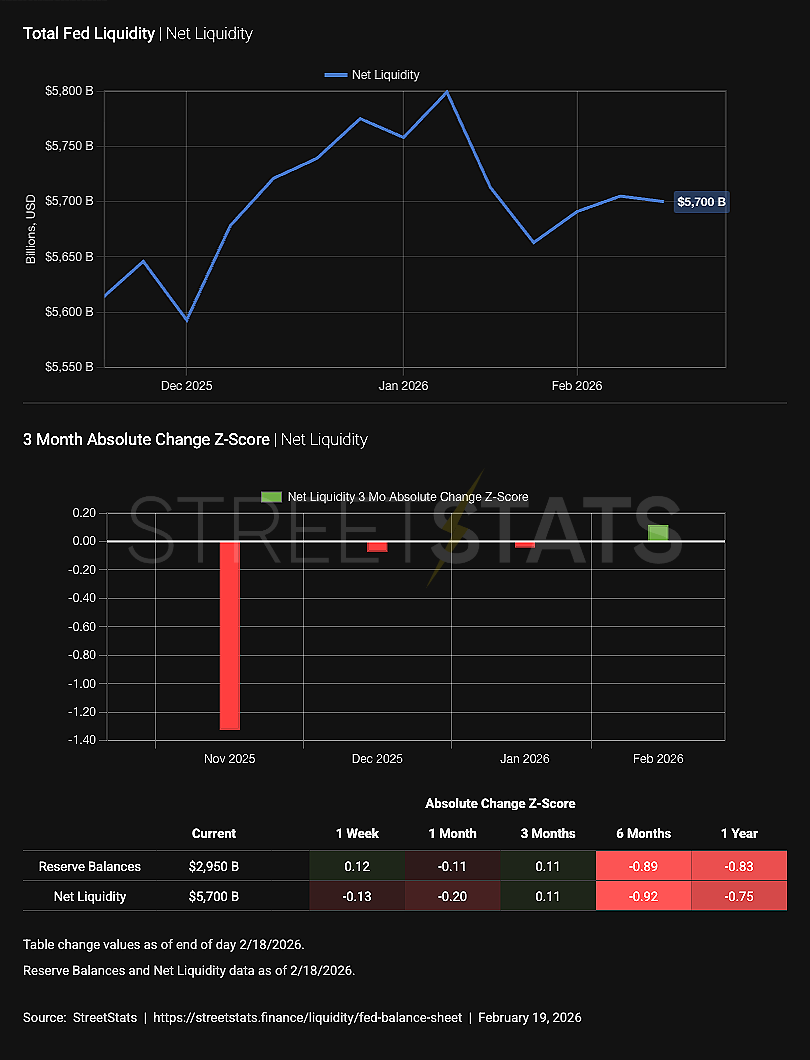
Fed assets minus Treasury cash minus reverse repo
The system has been hovering near $3 trillion in reserves.
This week nudged it lower.
Not a collapse. Not a crisis. But direction matters.
Plateaus break quietly before they break loudly.
The Liability Side Is Now the Driver
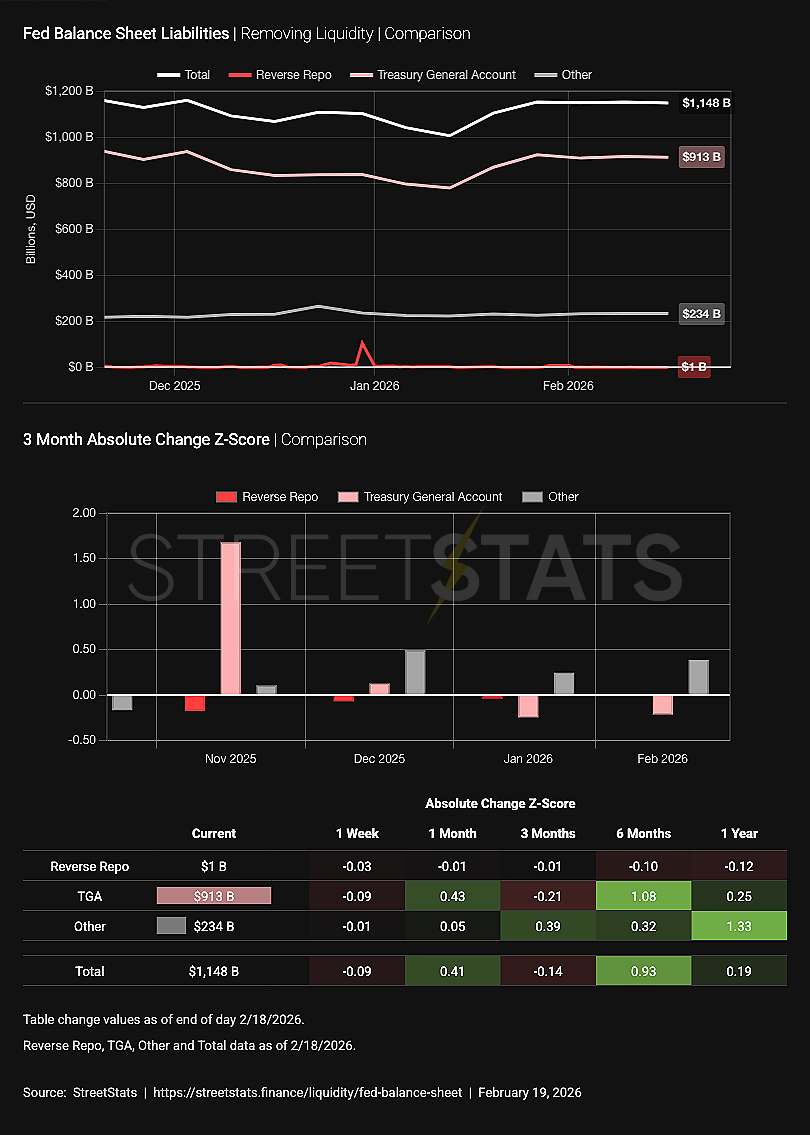
Assets add liquidity. These liabilities remove it
Two structural realities:
Reverse repo balances are no longer a massive shock absorber. During prior tightening cycles, liquidity drained from RRP before reserves were hit. That buffer is much smaller now.
The TGA is increasingly volatile and increasingly powerful. Large Treasury cash swings now move reserves quickly.
This week confirmed it.
Assets rose modestly.
Reserves fell materially.
The difference was the Treasury.
What Did Not Happen
No spike in primary credit.
No surge in swap lines.
No emergency facility reactivation.
No stealth QE acceleration.
This was not stress.
It was plumbing.
The Bitcoin Lens
Fed liquidity is not the only driver of Bitcoin.
Global liquidity matters. China’s credit cycle matters. Dollar funding conditions matter.
But Fed reserves anchor the system.
When reserve balances contract rapidly, risk assets rarely ignore it.
When reserves expand persistently, risk tends to breathe easier.
This week: reserves contracted.
One week does not define a regime.
But direction is worth watching.
Bitcoin has been operating in a liquidity plateau since QT ended. If Treasury-driven drains persist, that plateau could tilt.
If Reserve Management Purchases outpace Treasury rebuilding, reserves stabilize.
The balance sheet will tell us which path we’re on long before price confirms it.
The Regime as of February 18th, 2026
QT has ended.
Treasury bill holdings are rising.
MBS runoff continues.
The TGA is volatile.
Reverse repo is structurally smaller.
Reserves fell $53.3 billion this week .
No panic.
No easing.
Just movement.
And movement in liquidity precedes movement in markets.
Why This Exists
Every Thursday at 4:30 PM ET, the Federal Reserve releases this report.
Most people won’t read it.
But someone will refresh the page.
Scroll to reserve balances.
And know before the headlines.
That’s the edge.
Next week, we look again.
Because liquidity regimes don’t announce themselves.
They reveal themselves.
If this breakdown clarified something for you, subscribe below.
Each week, we read the H.4.1 so you don’t have to.
Markets follow narratives.
But they move on liquidity.