

Luke Gromen's Big Prediction About the Fed Came True. Here's What's Next.
He made a specific prediction about the Fed in January 2019. The repo market cracked nine months later. Here's how the rest of the scorecard looks.


A brilliant macro analyst made a set of predictions about the global monetary system. Here’s how they’ve held up.
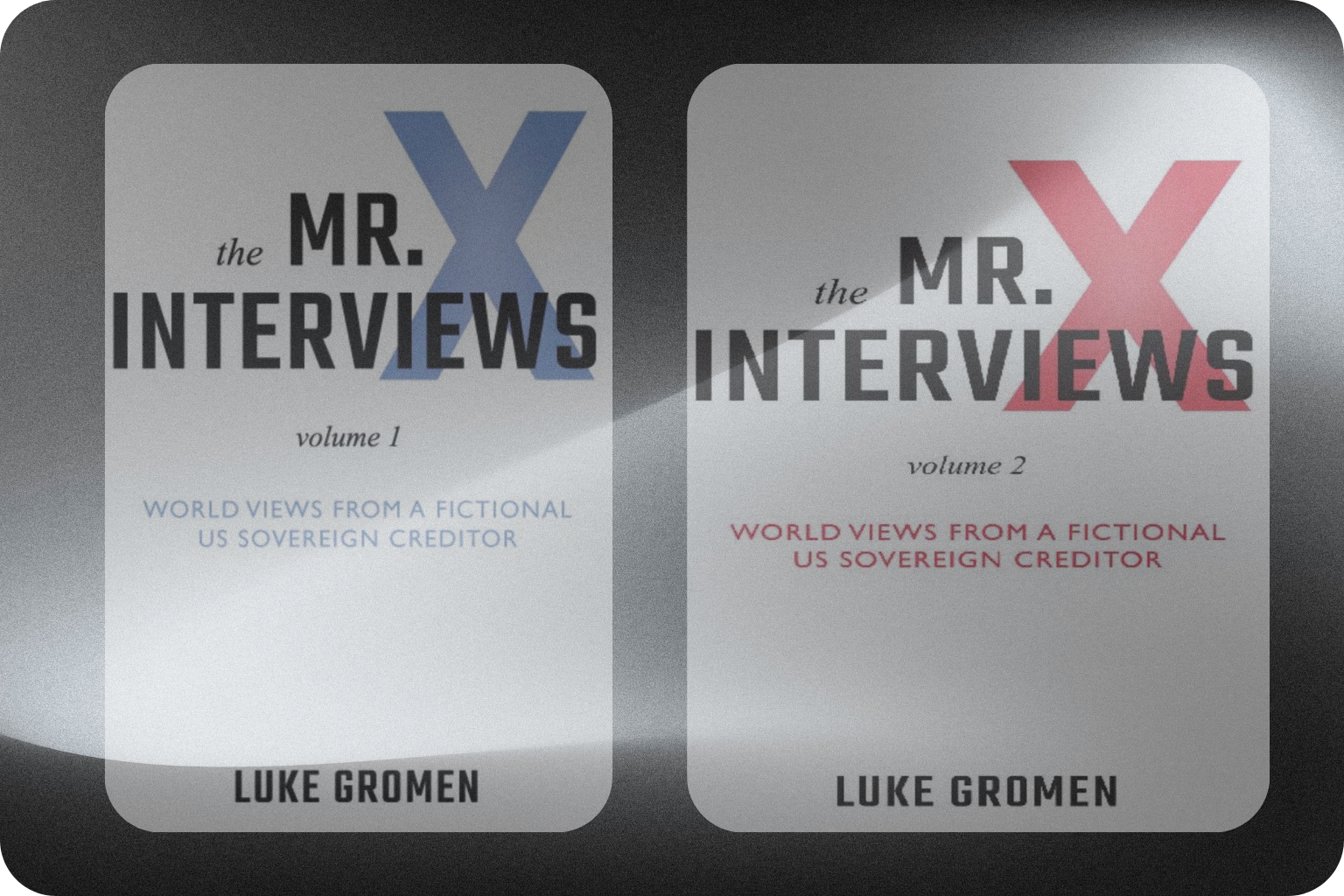
In 2016, a former Wall Street analyst sat down to write a fictional narrative that many people have never dug into.
Not a bestseller. No morning shows. No viral moment. It circulated — quietly, in PDF form — first through his research service then eventually book form as they gained popularity. Readers from macro analysts to sovereign debt watchers recognized something in it that mainstream financial commentary was missing.
The book was framed as a series of conversations between a macro strategist and “Mr. X” — a fictional sovereign creditor who had quietly stopped buying US Treasury bonds.
The reason Mr. X stopped buying wasn’t political. It was mathematical. The debt couldn’t be repaid in real terms. The compact between the US and its creditors — you protect us, we hold your paper — was quietly breaking down. Not with a bang, but with a slow, almost invisible reallocation of reserves away from Treasuries and toward gold.
That analyst was Luke Gromen. And the predictions embedded in those conversations have been coming in for years.
Who Is Gromen — and Why Does the Format Matter?
Luke Gromen isn’t a Bitcoin influencer. He doesn’t appear on cable news to tell you what markets will do next week. He’s a macro analyst — a former sell-side researcher who spent years at Midwest Research and Cleveland Research Company studying how sovereign nations manage their reserves, before founding his own research firm, FFTT (Forest for the Trees), which serves institutional clients including sovereign wealth funds.
The Mr. X books are structured as conversations. Volume 1 (2018) spans January 2016 through June 2017. Volume 2’s conversations run from October 2017 through January 2019, with the book published in 2020. The format matters, because Mr. X doesn’t speculate about what might happen. He speaks in past tense.
“We stopped buying Treasuries.”
“We diversified into gold.”
“We have been watching the United States for fifteen years, and we have reached a conclusion.”
This isn’t a trader talking about what he thinks will happen. It’s a composite portrait of what Gromen believed was already happening — quietly, in reserve management offices around the world where sovereign nations had done the same math and reached the same conclusion. The conversations aren’t theoretical. They’re a reconstruction of a present most people couldn’t see.
That framing matters when you look at the scorecard. Gromen wasn’t guessing at the future. He was trying to describe a present that almost nobody was paying attention to.
I’ll be honest: I’ve been listening to Gromen for a while, and there are still times I have to pause and do separate research just to follow what he’s saying. He operates at a level of macro depth that assumes you already know the plumbing. In my view, he is one of the best in the world at what he does — connecting sovereign debt dynamics, reserve flows, and monetary architecture into a coherent picture of where the world is actually headed. But he doesn’t make it easy. What he makes it is worth it.
The Core Thesis, in Plain English
To understand what Gromen predicted, you have to understand the system he was describing.
Start in 1971. President Nixon closes the gold window — the arrangement that had allowed foreign governments to exchange their dollars for gold at a fixed rate. With that gone, the dollar becomes what economists call a fiat currency: backed by nothing physical. Just the faith and credit of the United States government.
That’s a shaky foundation. The rest of the world knew it.
What came next is called the petrodollar system, and it’s worth understanding carefully because almost nothing about modern finance makes sense without it.
In 1973, Henry Kissinger led the negotiations of an arrangement with Saudi Arabia. The terms were simple: Saudi Arabia would price its oil exclusively in US dollars, and the United States would provide military protection for the Saudi regime. The other OPEC nations followed.
The result of that single arrangement: every country on earth that needed oil must first acquire dollars. And every country on earth needs oil.
Think of it as a cover charge.
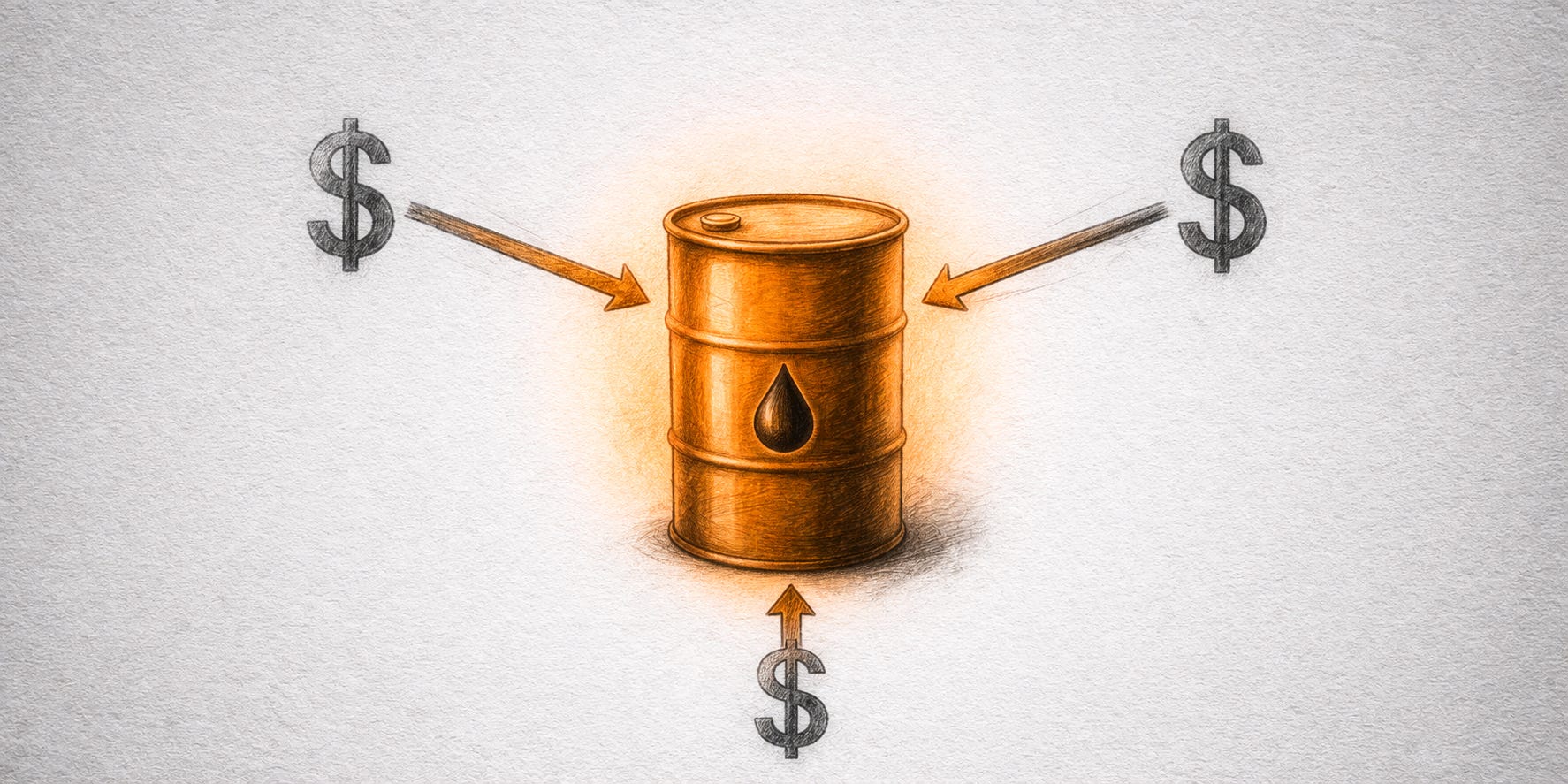
If you want to participate in the global energy economy, you have to hold dollars first. This creates something extraordinary — a permanent, structural, non-negotiable global demand for the US dollar. Not because America is especially virtuous or productive, but because the world needs oil and oil requires dollars.
This is what economists call the “exorbitant privilege.” And it’s real: a $900 billion annual military budget, over $2 trillion in annual deficits, more than $39 trillion in national debt that somehow keeps rolling over. All of it runs on the same structural foundation. As long as oil is priced in dollars, the world has no choice but to absorb them.
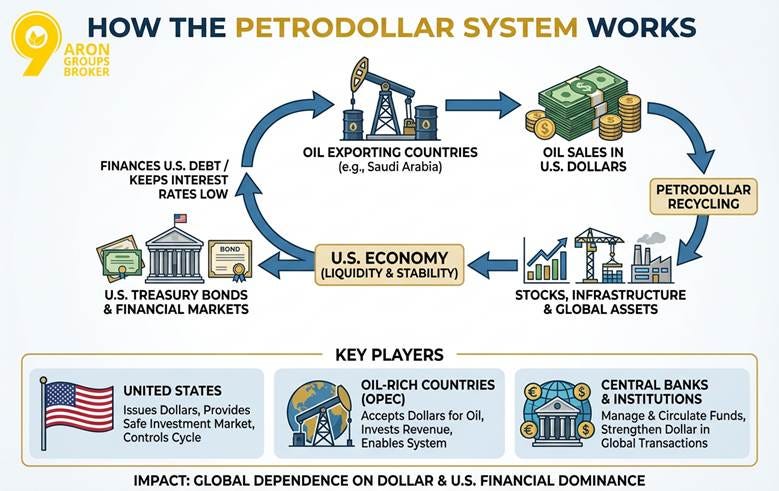
China's entry into the World Trade Organization in 2001 amplified this dynamic further. As Chinese exports flooded global markets, Beijing accumulated enormous dollar surpluses — which it recycled back into US Treasury bonds. By the mid-2000s, China had become one of the largest foreign holders of American debt, deepening the compact at exactly the moment the US was beginning to strain it: America runs the deficits, the world absorbs the dollars, the creditors hold the paper.
Gromen’s argument, beginning in 2016, was that this foundation was quietly cracking.
The compact worked as long as the US managed the dollar responsibly — kept deficits manageable, kept purchasing power roughly stable. It began breaking down after 2000, when deficits swelled and the dollar was increasingly used as a foreign policy weapon: sanctioning adversaries, excluding nations from SWIFT, freezing sovereign reserves. The 2008 crisis was the decisive credibility blow — the US applied different rules to itself than it had imposed on every emerging market that ever needed an IMF bailout. The message wasn’t subtle.
Mr. X’s summary: “Nobody wants to admit it, but we’re there. We arrived in 2008, and we have spent the last decade muddling along.”
Then there’s the math. The United States has more than $100 trillion in unfunded entitlement obligations — Social Security, Medicare, Medicaid — that grow with inflation and cannot be meaningfully reduced without a political cost no elected official wants to pay. National debt stands around $39 trillion, growing at roughly $8 billion per day. Debt-to-GDP is approximately 122–125%. The Congressional Budget Office projects it reaching 175% by 2056. In May 2025, Moody’s downgraded the US from AAA for the first time since 1917. Interest on the debt is approaching $1 trillion per year — consuming 15 to 20 cents of every dollar the federal government collects.
There is no realistic mathematical path to repaying this in real terms. And Gromen’s argument — drawn from precedents running through every sovereign debt crisis from Rome to FDR to post-WWI Germany — is that there never was. The only historically precedented resolution is some form of currency debasement paired with the revaluation of neutral reserve assets. The asset that has played that role throughout recorded history is gold.
The Scorecard
Gromen sharpened his most specific prediction in Volume 2. The epilogue, written in January 2019, predicted the Fed would be forced back into balance sheet expansion “no later than Q4 2019.” The book wasn’t published until 2020 — which means readers who picked it up could see the prediction and its confirmation sitting side by side.
In September 2019, the overnight repo market seized. Rates spiked to 10% — overnight. The Fed scrambled, injecting hundreds of billions in emergency liquidity within days. By October 2019, it was buying $60 billion per month in T-bills while publicly insisting “this is not QE.”
Gromen’s specific prediction, made nine months earlier, had just come true.
Then COVID arrived. And this is where it gets interesting.
COVID didn’t disprove the thesis. It masked it.
Here’s what would have happened without the pandemic: a slow, visible, politically explicit funding crisis. The repo market had already cracked. The Fed was already being forced to act. Without a global emergency to provide cover, that process would have continued in full public view — the “money system” conversation would have been front and center, with no alternative narrative to reframe it.
Instead, the pandemic gave policymakers political cover to do what the repo crisis was already forcing — but at ten times the scale, wrapped in a completely different story. Trillions in Fed balance sheet expansion weren’t framed as “the sovereign debt system is breaking and we have no choice.” They were framed as emergency pandemic relief. Humanitarian necessity.
The underlying pathology was treated with the largest dose in history of the same medicine that caused it. This bought time. It didn’t change the trajectory. It made the eventual reckoning larger.
Beyond the repo call, most of Gromen’s structural predictions have held up.
US fiscal deficits have widened structurally, exactly as he described. National debt has crossed $39 trillion. The CBO projects deficits running at 5 to 7 percent of GDP indefinitely.
Central banks have been buying gold at record pace — more than 1,000 tonnes per year in 2022, 2023, and 2024, three consecutive record years. The share of reserves held in gold has risen from roughly 15% to 20%. According to the World Gold Council, 95% of central banks surveyed expect global gold reserves to increase further, and 43% plan to increase their own holdings — a record high.
Gold itself has broken out. It sat in the $1,100–$1,350 range for years while Gromen’s framework was being written. It now trades close to $5,000, and hit an all time high of about $5,600 in January, 2026.
EU-Russia energy geopolitics played out along the lines he described — and then dramatically exceeded his predictions when Russia invaded Ukraine in 2022, triggering the full rupture of the European energy relationship he had been tracking.
Some predictions remain in play but unresolved: the yuan as a major oil pricing currency is real but not dominant. Formal gold revaluation on sovereign balance sheets is intellectually compelling but hasn’t happened as policy. The orderly restructuring of the dollar system is ongoing rather than complete.
But the direction — the structural direction he identified when almost nobody was listening — has been confirmed by nearly every indicator he named.

The Chapter He Didn’t Write
Here’s the question worth sitting with: why are central banks buying gold in record quantities?
It’s not sentiment. It’s not fashion. It’s the same math Gromen laid out. If sovereign debt can’t be repaid in real terms — and the numbers suggest it can’t — then the rational move for any institution managing long-term reserves is to accumulate the asset that benefits from that realization. An asset nobody can print more of. An asset with no counterparty. An asset that has served as the neutral reserve settlement layer for most of recorded human history.
When the institutions that create money start hedging against the money they create, that’s a signal worth taking seriously.
Now here’s the part Gromen’s books don’t quite get to — the individual version of that logic.
Central banks are buying gold because they’ve concluded that the dominant reserve asset can’t fulfill its promise in real terms over long timelines. They’re moving toward the asset with a finite supply, and centuries of precedent as a store of value. It’s the rational move for an institution that can think in 20-year timeframes.
Bitcoin is that same logic — with superior monetary properties — and it’s the version available to individuals rather than sovereign wealth funds.
Gold’s supply isn’t truly fixed. Mining continues. New deposits are found. Bitcoin’s supply is fixed — twenty-one million, governed by code, with no mechanism to change it. Gold requires physical storage, professional custody, and significant infrastructure to move across borders. Bitcoin can be held in self-custody on a hardware device smaller than a credit card and moved anywhere in the world in minutes. Gold’s physical nature made it the right neutral reserve asset for the era of sovereign states and central banks. Bitcoin’s properties make it the right answer for an era of digital finance and individuals who don’t have access to a Zurich vault.
Restate Gromen’s thesis in Bitcoin terms:
“Gold must be revalued to provide a debt jubilee” — Bitcoin is the harder, more divisible, more portable version of that same neutral reserve asset. Its supply doesn’t respond to price signals. You can’t discover and mine more of it when it gets expensive.
“Nations need a settlement layer that floats against all currencies” — Bitcoin is permanently open, permissionless, and accessible to anyone with a smartphone and an internet connection.
“Central banks buy gold because they know sovereign debt can’t be repaid” — if that’s the institution’s conclusion, the individual can reach the same conclusion. And act on it without a prime broker, a minimum account size, or a custody arrangement in Switzerland.
The central bank’s hedge and the individual’s hedge are pointing at the same underlying problem. Bitcoin is the version accessible to everyone.
What Still Could Happen — and Why It Matters
Gromen’s framework describes a world in transition, not one that has already arrived. The structural forces he identified have been building for decades. The resolution could unfold over years more. Timing macro transitions is notoriously difficult — the system has proven more elastic than almost anyone expected, absorbing crisis after crisis through the same mechanism of balance sheet expansion that is itself the underlying problem.
But the direction has been confirmed. That’s not a small thing.
Gromen himself, as of early 2026, remains cautious on Bitcoin in the near term — trimming exposure, noting technical deterioration in the BTC-to-gold ratio, flagging headwinds. This is worth respecting. The man whose macro framework most strongly implies Bitcoin’s long-term thesis isn’t pretending the near-term is simple. He’s being intellectually honest about what the data is doing.
But near-term caution and structural thesis are different things.
The structural thesis — the one laid out in those PDF conversations that circulated quietly among a small group of macro analysts when almost nobody was paying attention — has been directionally correct about nearly everything that matters.
The most revealing signal is still where the smart money is moving. Nations that think in 20-year timeframes, without a quarterly earnings call forcing their hand, are quietly accumulating gold at a pace the world hasn’t seen in a generation. Not because gold is fashionable. Because they’ve concluded the alternative — sovereign debt denominated in the currency of a nation that is structurally unable to balance its books — will not hold its value over the timelines that matter to them.
That same reasoning is available to you. The conclusion it points toward is available to you. And the asset it points toward — the one with the fixed supply, no counterparty risk, and global accessibility — is available in a way that gold bars in a Swiss vault never were.
Mr. X stopped buying Treasuries because the math no longer made sense.
Central banks bought more than a thousand tonnes of gold per year for three straight years because the math pointed somewhere else.
The math hasn’t changed. The positioning is just happening at different scales — and in different assets — depending on whether you run a sovereign wealth fund or a savings account.