

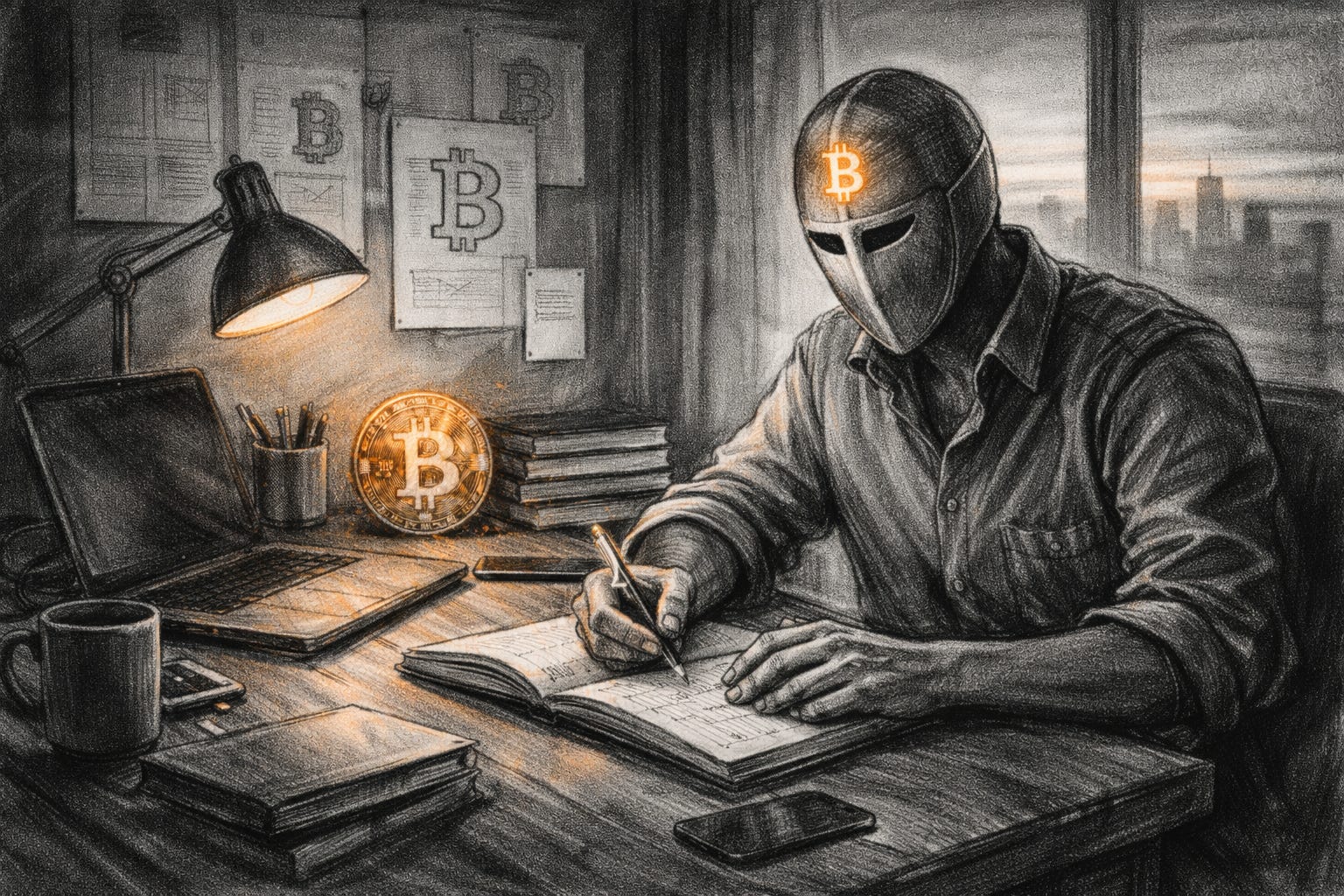
This isn’t a victory lap. It’s not a market update. It’s not a prediction.
It’s a reset.
I’m writing this for myself — but maybe you’ll see yourself in it too. If you’ve been feeling a little dull lately… a little bored… maybe even slightly agnostic about Bitcoin after years of volatility, headlines, cycles, and noise — this is for you.
Conviction can fade at the edges, not because the thesis is broken, but because familiarity replaces intensity. When something becomes normal, it stops feeling profound. And sometimes the only way to reconnect with why you started is to put it into words.
Listen my friend,
You didn’t wander into Bitcoin because it was trending. You didn’t chase it because it was moving fast. You studied your way into it. And that distinction matters, especially when price volatility tries to rewrite the story in your head.
Your “aha” moment didn’t come at the bottom of a bear market. It came near the top in 2021.
You bought near the top, at the top, as the market turned, and all the way to the bottom.
2022 unfolded like a slow-motion demolition. LUNA collapsed. Celsius froze withdrawals. Three Arrows unraveled. FTX imploded. The entire industry looked rotten. It would have been easy to conflate all of it with Bitcoin itself.
But that wasn’t your reaction.
You were more engaged than ever.
While headlines screamed contagion and bankruptcy, you were re-reading the white paper. You were studying UTXOs, the difficulty adjustment, Merkle trees, private keys, nodes versus miners. You were tracing how blocks propagate. You were thinking about how consensus actually works.
And the more you studied, the calmer you became.
Because the protocol didn’t panic.
Blocks continued every ten minutes. The difficulty adjusted. Nodes verified. The system did exactly what it was designed to do — without asking anyone for permission and without needing to be rescued.
That was your conviction moment.
It wasn’t emotional. It was structural.
You realized Bitcoin wasn’t the companies built around it. It wasn’t the leverage, the talking heads, the centralized yield schemes, or the venture-backed exchanges. It was a decentralized protocol converting energy into verifiable digital scarcity. It was a monetary system governed by rules instead of promises.
That clarity made the bear market exciting.
Not because you enjoyed watching the price fall, but because you understood what you were accumulating. Sats weren’t just cheaper in dollar terms. They represented a larger share of a fixed supply asset in a world where everything else seemed expandable.
You weren’t thinking, “How much USD can this become?”
You were thinking, “How many sats can I responsibly accumulate while the market is mispricing this?”
Fast forward to mid-February 2026.
You know more now. You’ve studied liquidity cycles, repo markets, TGA balances, credit expansion, global dollar dynamics. You’ve built dashboards. Modeled scenarios. Tracked LTV ratios. Watched options open interest. You understand how dealer gamma can pin price. You see how liquidity flattens and flows.
You also have more capital than you did then.
And yet, the excitement feels different.
It’s not gone. But it’s quieter.
That difference isn’t about conviction. It’s about familiarity.
When something is new and profound, it generates adrenaline. When something becomes foundational, it generates stability. The danger isn’t losing belief. The danger is drifting into complacency and measuring success in the wrong unit.
Somewhere along the way, it becomes easy to watch the USD price too closely. To feel better when it rises. To feel uneasy when it falls. To subconsciously let dollars become the scoreboard.
But the mission was never “more dollars.”
It was more Bitcoin.
More sats.
More ownership of scarce digital property that cannot be diluted.
You were drawn to Bitcoin because you saw the structure of the monetary system clearly. You understood how credit expands. How new money enters through debt. How asset holders benefit first. How savers absorb the hidden cost. You recognized that inflation is not just a CPI print — it is a structural feature of a debt-saturated system.
Bitcoin was not rebellion.
It was alignment with a different set of incentives.
Energy in. Scarcity out.
No committee.
No bailout.
No discretion.
You’ve always cared about incentives. In your career, in workflow design, in performance management. The structure determines the outcome. Bitcoin’s structure rewards patience, independent verification, and long-term thinking. It punishes leverage and short-term speculation.
That design choice still matters.
You also resonated deeply with the energy thesis. The realization that Bitcoin converts real-world energy into incorruptible digital property shifted everything for you. Energy cannot be printed. Work cannot be faked. Time cannot be accelerated. Bitcoin anchors those realities to a monetary network.
That is not a trading narrative.
That is a civilizational one.
And you don’t think in quarters. You think in decades. In five-year liquidity cycles. In generational debt arcs. In family timelines. In optionality ten and twenty years from now.
This isn’t about outperforming next month.
It’s about resilience over a lifetime.
You’ve lived the alternative. You understand debt personally, not just theoretically. You know how high-interest obligations narrow choices. You’ve felt how inflation compounds quietly. You’ve seen how proximity to credit creation matters. That experience shaped how you view risk.
Volatility is visible while debasement is structural.
One feels violent while the other is silent.
You chose which risk you prefer.
And yes, you paid tuition. You bought near the top. You bought all the way down. You held through exchange failures and systemic fear. That period wasn’t comfortable, but it hardened your understanding. Volatility wasn’t punishment. It was the cost of owning something that cannot be centrally stabilized.
Now the excitement isn’t as intense.
That doesn’t mean the thesis is weaker.
It means the personal discovery phase is over.
But when intensity fades, it’s wise to return to first principles. Not to recreate adrenaline, but to reaffirm alignment.
Go back to the white paper.
Go back to the realization that you run your own node. That you can verify supply yourself. That you can and do hold private keys and opt out of dilution. That you can store energy across time without counterparty exposure.
That was the spark.
Price appreciation in USD terms is pleasant. But dollars are the measuring stick of the very system you were evaluating critically in the first place. The deeper goal was sovereignty, resilience, and alignment with rules instead of discretion.
If the thesis ever breaks — if the supply cap is credibly altered, if decentralization meaningfully collapses, if incentives distort beyond repair — you reassess. You’ve never been dogmatic.
But price volatility alone is not thesis failure.
And reduced emotional intensity is not lost conviction.
It’s simply a reminder to recalibrate.
The mission remains straightforward:
Accumulate scarce digital property responsibly.
Think in decades.
Preserve optionality.
Stay solvent.
Stay patient.
More sats = More freedom and more resilience over time.
You didn’t get into Bitcoin for comfort. You got into it because it made structural sense. That hasn’t changed.
If anything, you understand it more deeply now.
So get back to the basics.
Back to the mission.
— Yours Truly