

Technology Wants to Make You Richer. The Monetary System Disagrees.
There's a war between technology and the monetary system. Most people don't know it's happening. Fewer know which side they're on.


Your phone is more powerful than the computer that guided Apollo 11 to the moon, and it costs less in real terms than it did ten years ago. Netflix gives you access to more entertainment than a 1990s millionaire could have purchased at any price. Amazon delivers goods in two days that used to require a trip to three different stores.
By almost every measure, technology is winning a relentless war against cost.
So why does it feel like you’re losing?
The Most Powerful Force in the Economy
Every technology follows the same arc: it starts expensive and rare, then becomes cheap and ubiquitous.
The iPhone collapsed a camera, a music player, a GPS, a computer, and a telephone into a single device that now costs less, in inflation-adjusted terms, than the original models did. Netflix turned what used to be a video store membership plus cable bill plus a shelf of DVDs into a single monthly subscription. Amazon turned the logistics of retail — warehouses, trucks, storefronts — into something that arrives at your door in 48 hours, often for less than you’d pay locally.
The pattern is consistent: once the infrastructure exists, adding one more user costs almost nothing. The marginal cost of streaming one more movie is essentially zero. The cost of distributing one more book, one more song, one more software update approaches zero as well.
Artificial intelligence is the most powerful version of this force yet. It isn’t just lowering the cost of goods — it’s lowering the cost of thinking and creating. Things that once required specialized expertise are becoming accessible to anyone with a laptop and a prompt.
Technology’s natural direction is toward abundance and lower prices. This is unambiguously good. It should be raising everyone’s standard of living.
In many ways, it is. But something else is happening at the same time.
Where the Gains Go
While most of our tech has gotten cheaper, notice what hasn’t.
Home prices. Rent. Stocks. Education. Healthcare.
These costs have climbed in almost every major economy for decades — not gently, but dramatically. And the split between what technology can do and what daily life actually costs is the central tension of modern financial life.
It isn’t random. It has a structure.
The clearest pattern is in assets. Home prices and equity markets don’t just rise with inflation — they rise faster than inflation, year after year, decade after decade. Rent follows home values upward because rent is the price of accessing a housing asset. When the asset’s value increases, the cost of using it increases with it.
This is where new money flows. When the money supply expands, that new money has to go somewhere. It doesn’t distribute itself evenly across everything you buy. It pools in the things that can hold it — in assets that store value. Printing new money is like pouring water into a system of buckets. Not all buckets fill equally. The water flows toward the containers it can stay in.
Healthcare and education follow a different mechanism but arrive at the same result. Technology is already beginning to threaten both — AI can diagnose, tutor, and consult at a fraction of the cost of a human specialist. These sectors should be following the same deflationary curve as everything else. But they haven’t. The reason: government-backed demand. Student loans guarantee that someone will pay almost any price for a degree. Medicare and insurance systems guarantee that someone will pay almost any price for care. When demand is subsidized regardless of price, the normal pressure technology creates — compete or become cheaper — doesn’t land the same way.
Two different mechanisms. The same underlying source: a monetary system that requires constant expansion, and routes the gains toward the people closest to the flow.
This Has a Name
The pattern has a name: the Cantillon Effect, from an 18th-century economist who noticed something simple. New money doesn’t arrive for everyone at the same time.
When new money enters the system, it moves outward from its point of creation. The people nearest that source — governments, banks, large asset holders — receive it first. They use it to buy assets before prices adjust. By the time the same money reaches workers in the form of wages, asset prices have already moved. The worker’s raise buys less house than it would have if they’d received the money at the beginning.
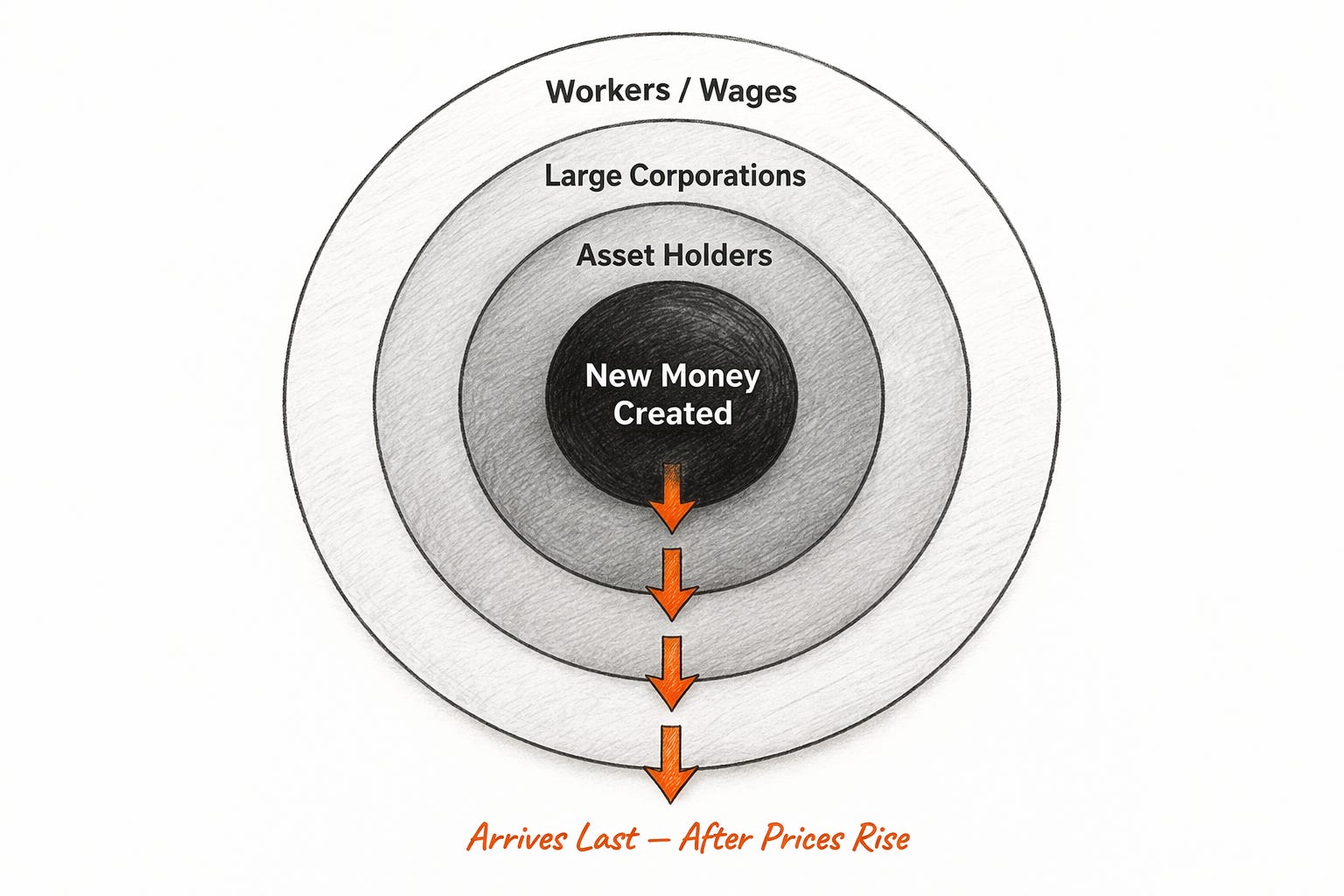
Technology’s deflation lands in (some) consumer goods — things workers buy. Monetary expansion lands in assets — things asset holders own.
This isn’t a conspiracy. It’s closer to physics. Water flows downhill. New money flows toward whatever can hold it, and it benefits the people who are already positioned to receive it first.
The person on the treadmill isn’t falling behind because they’re doing something wrong. They’re falling behind because the gains being generated — by technology, by productivity, by their own labor — are being quietly routed somewhere else.
The Endgame: Fiat Trillionaires
Follow this logic forward.
If technology keeps pushing consumer prices toward zero — and the evidence is strong that it will — and if the monetary system keeps expanding to sustain itself, what does the world eventually look like?
Nominal wealth denominated in fiat keeps growing. Not because more real value is being created, but because the unit of measurement keeps shrinking. We will see fiat trillionaires. The number will keep getting larger.
But a trillion dollars in a currency that has lost half its purchasing power isn’t the same trillion. The measuring stick is shorter than it was. Your grandchildren may be nominal millionaires — and still struggle to own a home, or afford healthcare, or save enough to retire.
This is the part that gets obscured by large numbers. When someone becomes a billionaire, it looks like an extraordinary accumulation of value. Some of it is. But part of it is simply the degradation of the unit they’re being measured in. The trillionaire of 2040 won’t be ten times wealthier than today’s billionaire in any real sense. They’ll be a person who stayed positioned close to the monetary system while the measuring stick quietly shrank.
An Asset That Sides with Technology
Every traditional store of value, in its own way, works against technology’s direction.
Real estate rises in fiat terms precisely because it absorbs monetary expansion. Equities rise in nominal terms even when the underlying corporate value is flat. Gold is finite but not programmatically fixed — there’s always another mine, another reserve, another discovery that can dilute its scarcity.
Bitcoin doesn’t fight technology — it extends it.
Its supply is fixed. Not approximately fixed, not fixed unless circumstances change. Fixed. There will never be more than 21 million bitcoin. New units cannot be created to absorb a shock, cover a deficit, or fund a war. The fixed supply exists in code, enforced by every participant in the network.
Jeff Booth’s argument in The Price of Tomorrow points toward something important here: if technology keeps making things cheaper in real terms, goods priced in bitcoin should fall over time. Technology and money, finally pointing in the same direction. An asset that rewards the same forces — productivity, innovation, efficiency — that technology rewards.
This is the first store of value in history that is structurally on the same side as human progress. It doesn’t require you to bet against technology. It requires you to bet with it.
The goal isn’t to accumulate ever-larger fiat numbers. That race has a moving finish line, and the people who set the rules move it whenever you get close. The goal is to preserve what you’ve earned against a system that has been quietly erasing it.
The War You Didn’t Know You Were In
The price war that defines modern economic life isn’t between Amazon and Walmart, or between the United States and China. It isn’t fought in quarterly earnings calls or on factory floors.
It’s fought between technology and the monetary system. One force relentlessly trying to make everything cheaper, more abundant, more accessible. One force quietly routing those gains to the people closest to the money supply, leaving the rest to run faster just to stay in place.
For most of modern economic history, the monetary system has won that war — and most people didn’t have a name for what was happening, let alone a way to step outside it.
Bitcoin doesn’t end the war. But for the first time, there’s an asset that lets you stand on technology’s side of the field.