

The Hidden Tide // Episode 4 — The Asset That Sits Outside the Tide
Why Bitcoin Reads the Market Three Months Early — And What That Actually Tells You


Global liquidity leads Bitcoin by thirteen weeks. The question worth asking is why.
One finding about Bitcoin has stuck with me more than most.
Global liquidity — the total capacity of the financial system to fund wants and needs — explains roughly 41% of Bitcoin’s price variation. And it leads Bitcoin by roughly thirteen weeks. The tide rises; Bitcoin follows, about three months later. The tide falls; same thing.
That’s not a loose correlation. For a single variable in a market as complex as global finance, it’s one of the strongest predictive relationships you can find. So I keep coming back to the same question: what kind of asset works this way, and why?
The honest answer requires looking at what Bitcoin actually is. Not what it does in a portfolio, but what it’s made of — and why that makes it structurally different from everything else competing for the same capital.
The water and what floats in it
Go back to the harbor from Episode 1 for a moment.
The tide is monetary inflation or the slow expansion of the money supply, and it doesn’t announce itself. It rises, year after year, against the same seawall. The marks from two decades ago sit well below the surface now. Most people, standing in the harbor, experience this as prices getting higher, savings not keeping up, the gap between income and assets quietly widening. That’s the water rising around them.
Some things float. Stocks. Real estate. Gold. When the money supply expands, the dollar price of assets rises — not because the assets got better, but because the unit used to measure them got weaker. More dollars chasing the same number of houses. More dollars chasing the same number of shares. The boat rises with the tide.
Here’s the part that gets less attention: every one of those assets is also made of the same substance as the water. Companies borrow dollars. Governments issue bonds denominated in dollars. Real estate appreciates in dollars, financed with dollar-denominated mortgages, appraised by standards that track dollar prices. The whole financial system runs on the same currency it keeps producing more of.
They float because they’re entangled with the thing that’s rising. Which also means they can’t escape it, at least for now.
The thing wired differently
Bitcoin has predetermined point where no new supply will be created. Ever. Already set. No issuer, no central bank, no committee that votes on whether to expand it when conditions call for it. The Fed can’t touch it. The Treasury has no mechanism to tap it. When the global dollar pool expands — through new debt issuance, central bank operations, the constant refinancing of the world’s outstanding obligations — Bitcoin’s supply doesn’t expand alongside it.
This is the structural difference. Not that Bitcoin is better at storing value in any particular week or year. The short-run chart argues otherwise often enough. The difference is what it’s made of.
Every other option on the conventional financial menu — savings account, 401k, stocks, real estate — is denominated in the same thing the system keeps producing more of. Your 401k balance is in dollars. The house is priced in dollars. The bond pays you in dollars. That’s the denominator. And the denominator keeps expanding.
Bitcoin is denominated in itself. There are no extra units to issue, no way to dilute the denominator. When someone says their Bitcoin is “worth” a certain amount, what they mean is: this fixed-supply thing, measured in a currency that keeps expanding, is currently trading at this price. The expanding side of that equation is the dollars. Not the Bitcoin.
Why the barometer reads the tide first
When global liquidity expands, capital moves before most people notice it moving. It flows first into the most liquid, most accessible assets — not into factories or wages or grocery bills. Bitcoin is the most liquid ‘risk’ asset on the planet. It trades around the clock, every day of the year, across every time zone, with no closing bell and no minimum investment. When new money enters the system and needs somewhere to go, Bitcoin is an extremely convenient option.
The reverse is also true. When liquidity contracts, Bitcoin shows it first — before the stock market fully reprices, before corporate earnings reflect it, before the economic data catches up.
This is the difference between a balloon and a barometer.
Most financial assets are like balloons. They rise with the tide because they’re puffed up by the same air. Some of that air — the borrowing, the leverage, the dollar issuance — is what inflates them in the first place. They participate in creating the tide and then float on it.
Bitcoin reads the pressure without creating it.
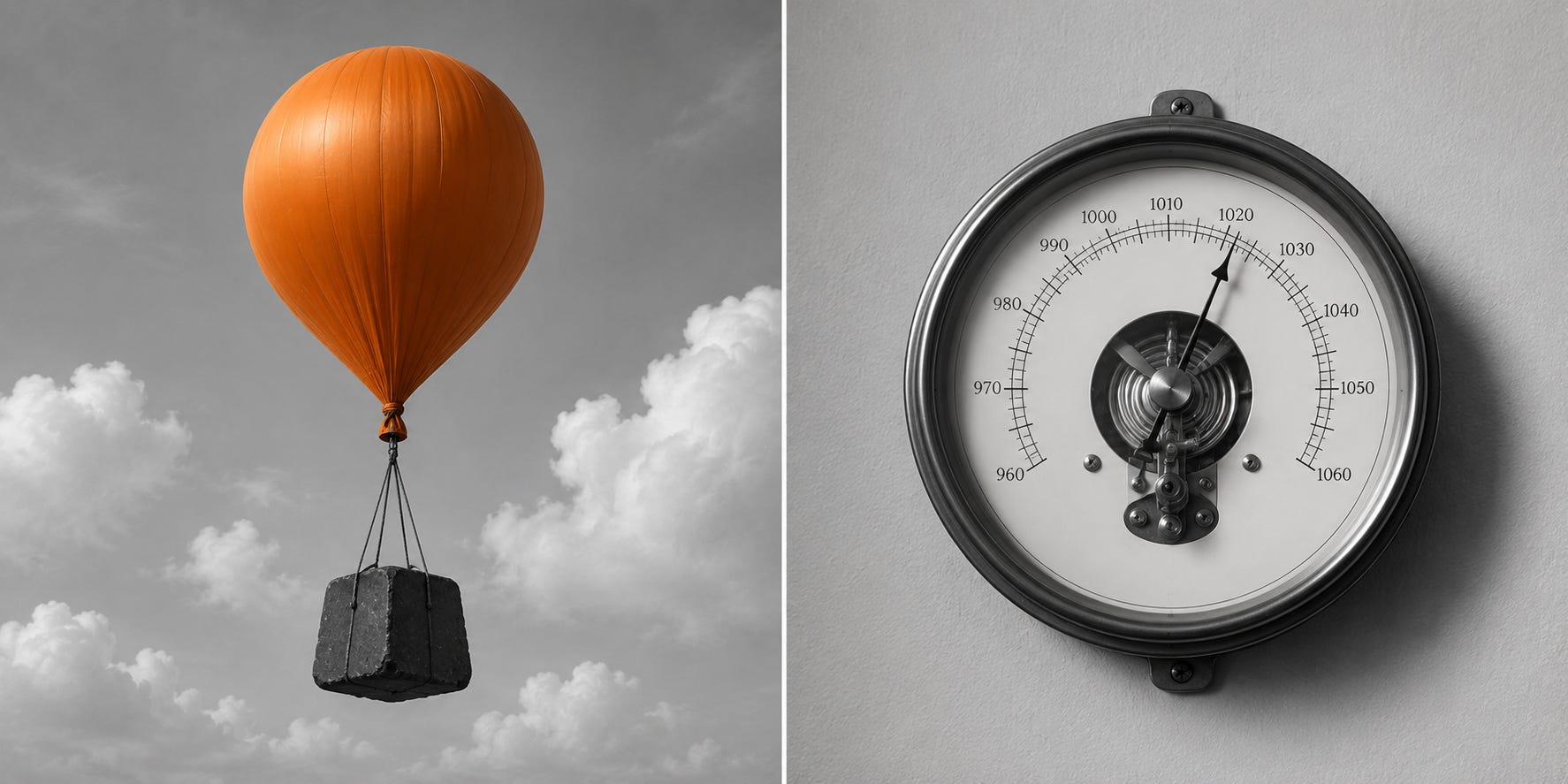
No one issues Bitcoin to fund a government deficit. No central bank can expand the supply to ease credit conditions. It sits outside the machinery that generates the tide, which is exactly why it can register the tide so precisely. A barometer doesn’t make the weather. That’s what makes it useful.
The arithmetic of a fixed denominator
Here’s where this gets simple.
Total dollars in the global financial system trends upward over time. Not in a straight line — the roughly 65-month cycle I wrote about in Episode 3 pushes it up and down with regularity. But the trend is up, because the debt that generates the dollar supply never gets paid off; it gets refinanced. More debt, more dollars needed to service it, more dollars in the system. This is structural. It doesn’t depend on which party is in power or what the Fed chair says at the next press conference.
Bitcoin’s supply doesn’t trend anywhere. 95% released already, with the last fraction mined around 2140. No upward drift. No expansion in response to demand.
Numerator trending up, denominator fixed. The long-run direction of Bitcoin’s price in dollars follows from that. Not in any particular week or year — the short-run is all cycle, all volatility, all the reasons the chart looks terrifying to anyone watching it day to day. Over any sufficiently long window, the arithmetic points one direction.
This is a structural observation. I’m not telling you when or how much. The math doesn’t address the timing.
What you’re actually choosing between
Three episodes in, the picture is clearer.
Episode 1 established that the money you earn loses purchasing power over time, and it is designed that way. The chosen solution to the debt problem is inflation, slow and tolerable enough that most people absorb it without seeing it clearly.
Episode 2 established that the gains from monetary expansion flow first to whoever already holds assets, and that people whose primary asset is their labor have been watching the goalpost move for decades.
Episode 3 established that the force actually driving market cycles is global liquidity — a tide running on a roughly five to six year rhythm, with Bitcoin registering its movements three months in advance.
This episode adds one more piece: every conventional option for storing the value of your work is denominated in the same thing the system keeps expanding. There is one widely accessible major asset that isn’t.
The question isn’t whether Bitcoin is the right choice for you. That depends on things I can’t know about your situation. But there’s a choice being made every time you decide where to put the value of your work, and most people make it without knowing everything they’re choosing between.
That’s what I’m trying to illuminate with this series.
The tide has been rising for decades. The marks on the seawall tell the story. Everything in the harbor floats, sinks, or treads water relative to the water line, and most people spend their financial lives trying to pick the best swimmers.
Very few ask whether there’s anything to stand on that’s above the waterline entirely.
I’m not sure the question has a clean answer. But it’s the right question to be asking.
The Hidden Tide is a series exploring the forces that shape money, markets, and wealth — for readers who never planned to become financial experts. Each piece stands alone. Read them in sequence and the picture gets bigger.