

Why Liquidity Flows to Bitcoin
Whether you believe it or not


Place a towel between two cups of water — one nearly full, one nearly empty — and leave them alone. Over time, without any pump or mechanism or intervention, the dry cup slowly rises. Moisture migrates across the towel not because anyone directed it, but because imbalance demands resolution.
Wet seeks dry.
Once you see it, you start noticing this pattern everywhere. Including in money.
The Principle Is Older Than Economics
Nature doesn’t require instructions for this. The process is automatic — imbalance creates movement, and movement continues until equilibrium is reached or the conditions change. Moisture flows from concentration to scarcity. Heat flows from warm to cool. Pressure equalizes across a membrane.
What’s interesting about these physical laws is that nothing has to be convinced. You don’t motivate water to move across a towel. You create the conditions, and the process unfolds on its own.
Money behaves remarkably similarly.
The System Is Wet
Liquidity is the word economists use for the money and credit flowing through the financial system at any given time — roughly, it’s the ability to fund wants and needs. Think of it less as cash in a wallet and more as the total capacity of the system to transact.
And today, that system is extraordinarily wet.
Trillions of dollars circulate through sovereign debt markets, equity exchanges, derivative contracts, and institutional balance sheets. More is created every year — through government spending, credit expansion, and monetary policy that has compounded for decades. The supply of liquidity keeps growing.
But here’s what doesn’t get said clearly enough: that liquidity doesn’t spread evenly. It pools.
Credit flows first to those who already have collateral.

Asset prices rise fastest for those who already hold assets. New money enters the system near its source — meaning it flows first to the institutions, governments, and large borrowers who create or receive it directly. Banks lend before savers deposit. Asset prices rise before wages follow. By the time that new purchasing power filters outward into paychecks and savings accounts, much of its value has already been captured by those who were first in line.
For most people, this creates a strange feeling. You work hard, you save carefully, and yet the gap never quite closes. Your paycheck rises, but so does everything you’re trying to buy. Holding cash feels responsible until you notice it buys a little less every year. Saving feels like treading water.
And yet the system keeps creating more liquidity. So where does it actually go, over time?
The Traditional Towels
The liquidity that keeps expanding has to go somewhere. History has a clear answer.
Real estate. Equities. Fine art. Collectibles. Gold.
For decades, these assets have absorbed the excess liquidity that fiat systems keep generating — and that’s a significant part of why they have consistently outpaced wages. Not because homeowners and equity holders are smarter or more productive than anyone else, but because they positioned themselves where the moisture flows. Value moves toward assets that resist evaporation. When more money chases the same pool of houses, shares, or gold bars, prices rise. That’s not luck — that’s the same physics as the towel.
But these towels carry a steep admission price.
Buying real estate requires a down payment, financing, and often years of financial preparation just to qualify. Equities require existing capital to deploy. Fine art exists in a world of auctions and relationships that most people will never touch. Gold is accessible in small quantities but cumbersome to store, move, and verify at scale.
The system rewards those who are already inside. Not through conspiracy — this is just how asset-based wealth accumulation works. You need proximity to capital in order to absorb more capital. Credit flows to those with collateral. Asset inflation benefits owners before earners. Over time, these dynamics reinforce each other, quietly and automatically.
For ordinary people, the towels have always been just slightly out of reach.

Bitcoin Started Dry
Bitcoin didn’t begin as a trusted asset. It didn’t have institutional backing or government endorsement. When it launched in 2009, it had almost nothing that conventional finance would recognize as a foundation for value.
What it had instead was constraint.
A fixed supply — only 21 million bitcoin will ever exist. A fixed issuance schedule, with new supply programmed to decrease over time as the protocol ages. No central issuer with discretion over how much to create. No authority capable of altering the rules to suit political or economic convenience. No mechanism for diluting existing holders when it becomes convenient to do so.
In other words, Bitcoin was dry by design.
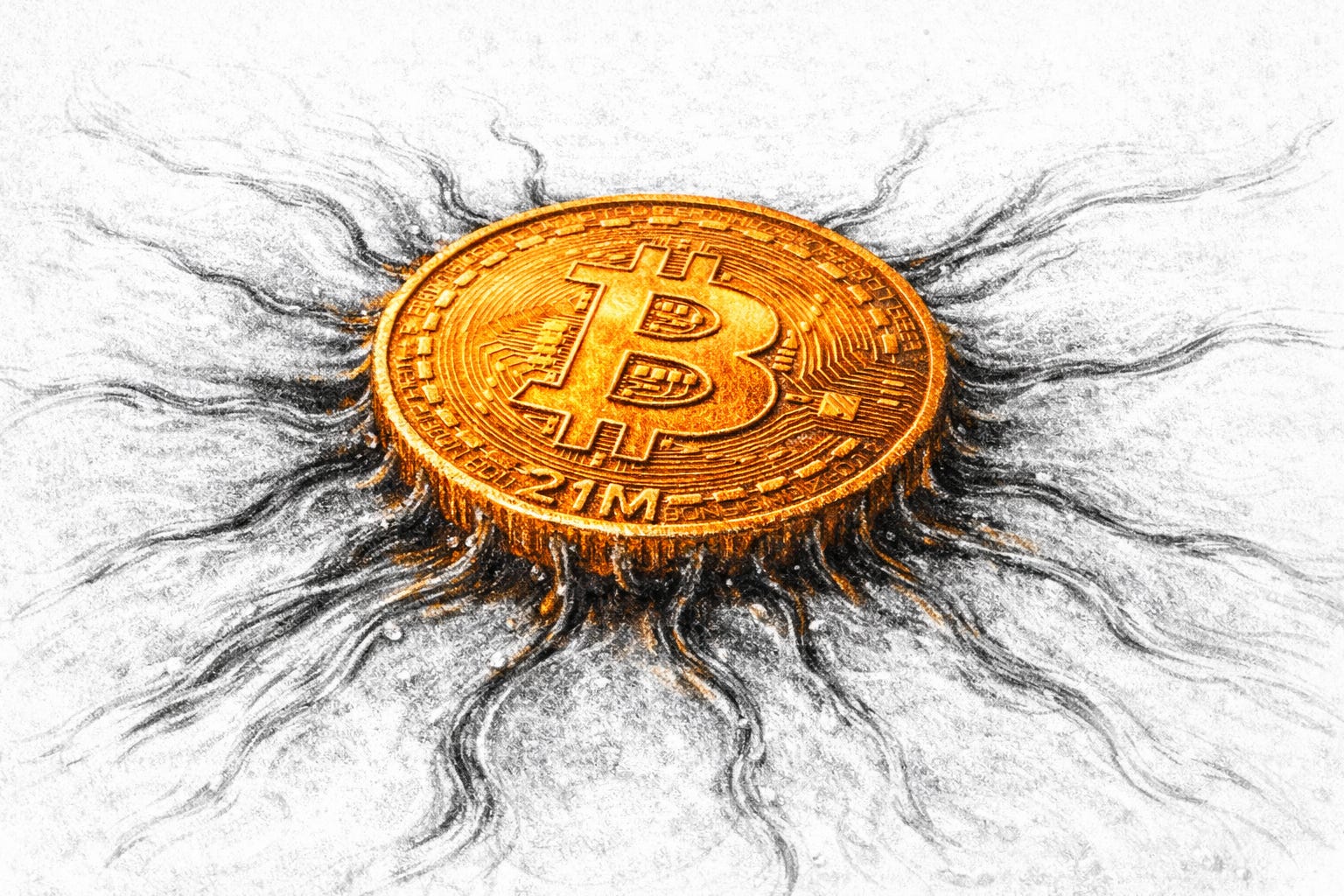
What the traditional towels share — what makes real estate, gold, and equities effective stores of value — is that their supply is difficult to expand quickly.
Bitcoin has that same quality, but with far greater precision. Its constraints are not physical or political. They are mathematical. Absolute. The rules cannot be changed to suit the moment, regardless of who is asking.
The reasoning chain is almost mechanical. Monetary expansion happens. Liquidity needs somewhere to go. It flows toward assets that preserve value.
Bitcoin is structurally the driest surface in the system. The flow follows.
This isn’t a prediction. It’s a description of how imbalance resolves.
A Towel Anyone Can Hold
Bitcoin changes this specific dynamic.
It is the first globally accessible asset that functions as a liquidity absorber without requiring scale, privilege, or intermediaries.
You don’t need a down payment. You don’t need a portfolio manager. You don’t need collateral, favorable credit, or a relationship with anyone. You need a smartphone and an internet connection, and you can acquire any amount — no minimums, no gatekeepers.

A satoshi is the smallest unit of bitcoin — one hundred millionth of a single coin — and even a single satoshi represents a portion of a fixed, immutable supply. Each one is like a small fiber in that towel.
On its own, it seems insignificant. But collectively, those fibers create a surface with genuine absorptive capacity.
This reframes what it means to hold Bitcoin. It isn’t primarily about trading price movements or timing the market. It’s about placement — positioning yourself on the surface where liquidity naturally wants to settle as the monetary system expands.
Bitcoin’s supply cannot expand to meet demand. New coins are still issued, but at a declining rate that trends toward a fixed cap. As liquidity grows, it increasingly bids on a supply that is becoming harder to expand.
The people who hold Bitcoin absorb that monetary expansion passively, simply by being in position. No leverage. No complexity. Just holding something that cannot be made wetter.
This is not a promise of riches. It is an observation about structural physics.
Not a Shortcut — A Different Set of Constraints
None of this is an argument for trading, or for watching price movements daily, or for making dramatic moves with capital you can’t afford to lose.
If anything, the wet-to-dry framework points in the opposite direction.
Trading and timing are attempts to outmaneuver a system that runs on its own terms — to use the same short-horizon reflexes that proximity to credit rewards. Bitcoin’s absorptive function doesn’t work that way.
It works through patience. Through holding something dry for long enough that the natural flow of liquidity reaches it.
In a system that privileges proximity over prudence, Bitcoin offers a different arrangement: constraints that favor discipline over discretion, patience over access.
It doesn’t fix wealth inequality. It doesn’t reverse what decades of fiat expansion have built. But it provides something that hasn’t existed before — access to the absorption process itself, for anyone willing to hold on long enough for the moisture to move.
The Towel Is Available
You don’t argue with gravity. You don’t negotiate with thermodynamics. You don’t convince moisture to migrate across a towel.
You just place it.
Bitcoin doesn’t command capital. It attracts it — because it is structurally dry in a system that keeps producing more wet. Wet seeks dry. Value seeks durability. Over long enough time horizons, that distinction matters in ways that no argument will speed up and no skepticism will slow down.
The process is already underway.
The only question is whether you’ve placed the towel.