



There are market environments that reward activity.
And there are market environments that quietly punish it.
Late January 2026 feels firmly in the second category.
Not because Bitcoin is broken.
Not because the long-term thesis has changed.
But because the forces currently shaping price have very little to do with organic trend discovery.
If you’ve felt frustrated trying to trade this market—if good ideas haven’t paid, if conviction keeps getting chopped up—you’re not imagining it.
This is a market designed to exhaust participants, not reward them.
Bitcoin Isn’t Trending. It’s Being Managed.
At a high level, Bitcoin is stuck in a range.
But why it’s stuck matters more than the range itself.
Price action right now is being dominated by:
Options expiry dynamics
Dealer gamma positioning
Liquidity games around obvious levels
In other words, derivatives structure, not spot conviction, is setting the tempo.
When options open interest is elevated—as it is now—price behaves less like a signal and more like a mechanism. Moves happen because they need to, not because new information is being discovered.
That’s how you end up with:
Sharp moves that fade quickly
Breakouts that don’t follow through
“Obvious” levels that fail
This isn’t randomness.
It’s reflexivity.
And reflexive markets are brutal for traders.
Elevated Open Interest + Mild Funding = Chop
One of the more deceptive aspects of this environment is that funding isn’t extreme.
It’s modestly positive.
Nothing euphoric.
But that’s precisely the issue.
High open interest combined with neutral-to-slightly-positive funding creates a market where:
There’s plenty of leverage
But no side is offsides enough to force resolution
That’s the recipe for range-bound, mean-reverting price action.
Every move feels like it should continue.
And almost none of them do.
This is the kind of market that:
Punishes directional conviction
Rewards option sellers
Slowly drains emotional capital
Liquidity Momentum Is Flattening
Trends thrive on expanding liquidity.
They struggle when liquidity momentum flattens.
Right now, global liquidity isn’t collapsing—but it’s no longer accelerating in a way that reliably fuels sustained trends.
That doesn’t mean Bitcoin has to crash.
It means clean continuation becomes less likely.
In these phases, markets tend to:
Rotate instead of trend
Test patience instead of rewarding speed
Grind participants down rather than flush them out
This is where overtrading becomes dangerous—not because you’re wrong, but because you’re early, late, and exhausted at the same time.
The 100-Week SMA: A Level That Actually Matters
Not all technical levels are equal.
Most are noise.
Some are self-referential.
The 100-week simple moving average is neither.
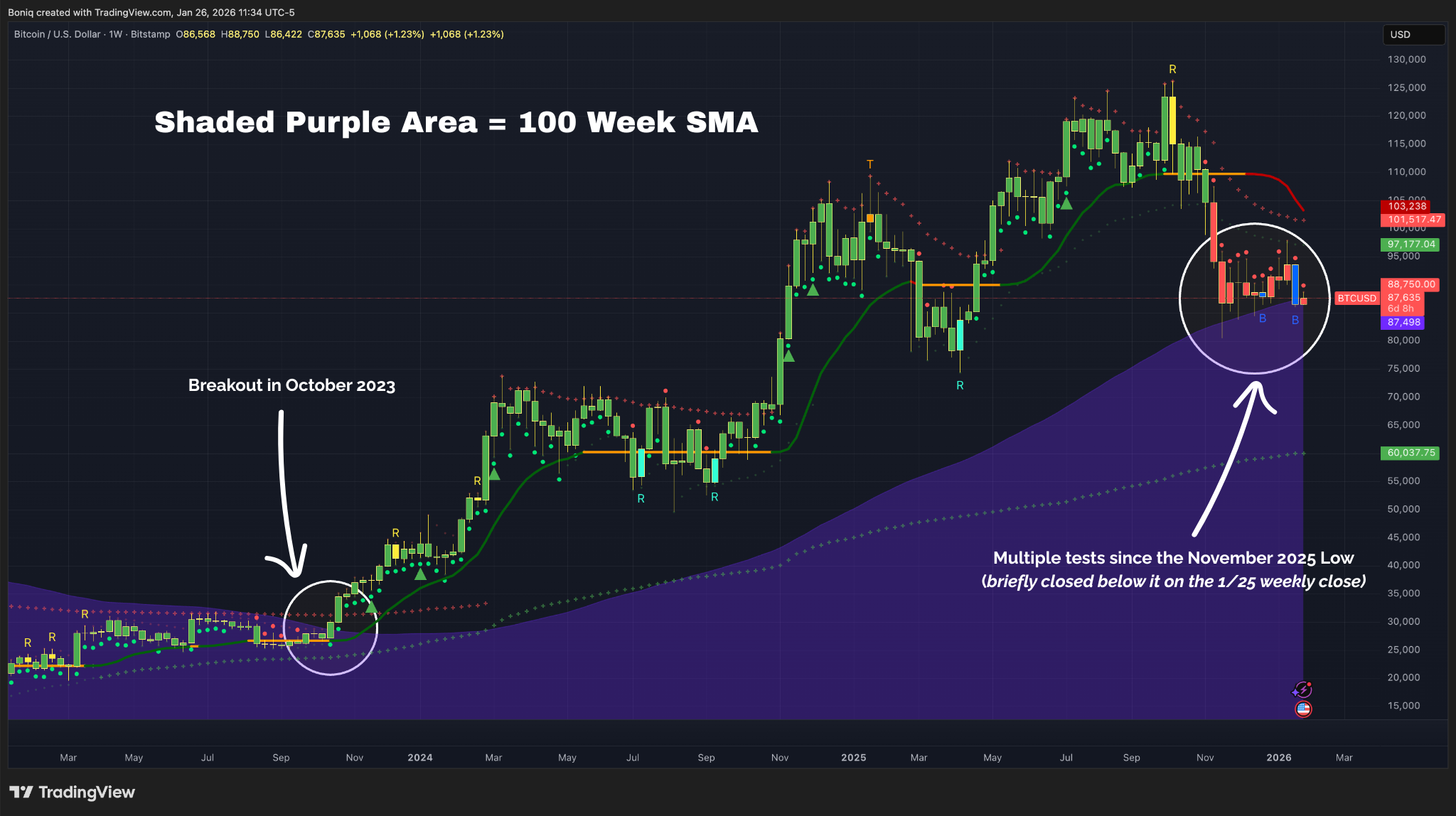
Historically, it has acted as a regime-defining level for Bitcoin.
A simple framework:
Above the 100-week SMA:
The long-term uptrend remains intact, even if volatility is uncomfortable.Sustained breakdown (~5% or more):
That’s when a meaningful shift toward longer term bear-market conditions becomes likely.
This level isn’t important because it’s magical.
It’s important because it reflects long-duration consensus.
The last sustained reclaim of the 100-week SMA—October 2023—marked the beginning of the current bull phase. That wasn’t obvious in real time. It only became clear after patience was rewarded.
That’s the lesson.
Why Trading This Environment Mostly Benefits Someone Else
Range-bound, option-heavy markets don’t reward most participants.
They reward:
Market makers
Option sellers
Those paid to provide liquidity, not chase it
Everyone else pays in:
Fees
Slippage
Failed follow-through
Emotional fatigue
And emotional fatigue matters.
Because emotional capital is finite.
If you burn it trying to force trades in a market that isn’t offering clean signals, you won’t have it when the environment actually changes.
Process Over Prediction
This isn’t a call to be bullish.
It isn’t a call to be bearish.
It’s a call to be disciplined.
For most participants, this market does not demand activity.
It rewards process.
That means:
Dollar-cost averaging instead of timing
Risk-managed positioning instead of leverage
Letting time work instead of fighting structure
You don’t need to predict when the market shifts.
You need to still be intact when it does.
A Simple Framework Going Forward
Something practical:
What to Watch
Behavior around the 100-week SMA
Changes in liquidity momentum (not single data points)
Structural shifts in open interest and funding
What Not to Overreact To
Short-term breakouts inside a range
Headlines attached to routine volatility
Price moves into options expiry
How to Stay Positioned Without Overtrading
Maintain a DCA plan you can execute without emotion
Size positions so volatility doesn’t force decisions
Protect emotional capital as deliberately as financial capital
Final Thought
Not every phase of a bull market feels exciting.
Some phases feel dull.
Some feel frustrating.
Some quietly test discipline more than conviction.
This appears to be one of them.
If you can resist the urge to do something—if you can focus on staying solvent, sane, and positioned—you’re already ahead of most participants.
And more often than not, that’s the real edge.
If you want next steps, I can:
Add a short TL;DR opener
Cut this down to a tighter “letter-length” post
Or build a follow-up focused purely on emotional capital & investor psychology in range markets
Just tell me the direction.